Wednesday, November 19, 2025

Etegami Horse Challenge

 2026 Year of the Horse

Etegami Exhibit 


Debbie Davidson (Hokkaido, JP)


Andrew Stone (Florence, ITALY)


Fumiko Koga (Saga, JP) 


Amanda Harlow (Hokkaido JP)


Debbie Davidson (Hokkaido, JP)


Lisa Jastram (Texas, USA)


Dvorah Adachihara (Nice, FRANCE)


 Marita McVeigh (Pennsylvania, USA)


Jayne Heetderks (New York, USA)


 Debbie Davidson (Hokkaido, JP)


Thank you to all the etegami artists who joined me in this challenge in spite of it being such a busy time of the year. Whatever your personal circumstances or that of our world and times in general, may each of you have a meaningful and rewarding year of the horse in 2026. May you stay curious and creative. May your spirits be high.


dosankodebbie 

Wednesday, January 22, 2025

Year-of-the-snake Etegami Exhibit

Welcome to our online exhibit of the 2025 Year-of-the-Snake Etegami Call (ended on February 1, 2025) brought to you by the Facebook group "Etegami Fun Club."  Although not restrictive as to materials or style, the tools of traditional etegami are the ink brush, the coloring brush, gansai water colors, sumi ink, and washi postcards. Brief words must accompany a simple image to make it etegami. The traditional purpose of an etegami is not so much to be displayed, as to be sent by post from a sender to a receiver in a shared experience. Hence the name "e"= picture + "tegami"= letter. The submissions were painted on 4 x 6 washi postcards, and, for the purpose of the exhibit, placed in the paperboard frames often used by senders or receivers of etegami to hang the work on their walls. The artists' names and translation of accompanying words are displayed above each work they submitted. The submissions are displayed in no particular order. (dosankodebbie: admin)


Submissions


Betsy Harting, state of Delaware US

 (巳年 2025)


Robin Scanlon, state of Hawaii US 

 (新年おめでとう 2025)  


Lisa Jastram, state of Texas US

 (蛇が脱皮するように我々も過去を何度でも脱皮しなければならない)


Hideko Sonomura, Fukui prefecture JP

 (translation: Let's be friends forever and ever)  


 dosankodebbie, Hokkaido prefecture JP
(最高の一年に滑り込もう)
 
 
 Fumiko Koga, Saga prefecture JP 

 (translation: Happy New Year 2025.)


Shay Niimi Wahl, state of Hawaii US 

 (サーフィンしながら2025年に入る)


dosankodebbie, Hokkaido prefecture JP
(初巳の出,  first snake-rise of the year)


Jayne Heetderks, state of New York US

(隠れた賜物。愛の視線で2025年をみつめよう。)


dosankodebbie, Hokkaido prefecture JP

 (星屑をつまむ蛇)


Fumiko Koga, Saga prefecture JP 

 (translation: Happiness is above the clouds, happiness is above the sky.) 


dosankodebbie, Hokkaido prefecture JP
(迂回を恐れるな)


 Dvorah Massa-Adachihara,  Nice FRANCE

 (2025年。これから何が?)


Karen Aigel Dinger, state of Pennsylvania US

 (物語はいつも蛇から始まるようだ。新年おめでとう、出発おめでとう)


Shay Niimi Wahl, state of Hawaii US 

 (踊りながら2025年に入る)


Marita McVeigh, state of Pennsylvania, US

(あけましておめでそう2025) 

 Snakes in Japanese Culture

This animal has long been regarded in Japan as an auspicious being that brings about good fortune and fertility. Since snakes grow and repeatedly shed their skin, they are also considered to be symbols of rebirth and resurrection, as well as vitality, immortality, infinity and prosperity.

Thursday, October 3, 2024

Owl Call Exhibit

Welcome to our online exhibit of the 2024 Owl Etegami Call (ended on October 1, 2024) brought to you by the Facebook group "Etegami Fun Club."  Although not restrictive as to materials or style, the tools of traditional etegami are the ink brush, the coloring brush, gansai water colors, sumi ink, and washi postcards. Brief words must accompany a simple image to make it etegami. The traditional purpose of an etegami is not so much to be displayed, as to be sent by post from a sender to a receiver in a shared experience. Hence the name "e"= picture + "tegami"= letter. The submissions were painted on 4 x 6 washi postcards, and, for the purpose of the exhibit, placed in the paperboard frames often used by senders or receivers of etegami to hang the work on their walls. The artists' names and translation of accompanying words are displayed above each work they submitted. The submissions are displayed in no particular order. (dosankodebbie: admin)


Fumiko Koga, Saga prefecture JP 

 (translation: No, I'm not angry. I'm just watching out for you.)


Robin Scanlon, state of Hawaii US

  (自由に飛べ)


Hideko Sonomura, Fukui prefecture JP

  (translation: Half a century of synchronicity between us) 


dosankodebbie, Hokkaido prefecture JP
(ぼくはママのかけがえの無い存在)


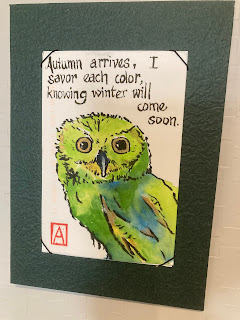
Alice Webb, state of Arizona US 

 (冬がこのすぐ先にあると認識して、秋の色をひとつ一つしっかり味わう)


Jackie Bufton, Torquay UK

 (梟は見て聞くが、見て聞いたことは決して漏らさない)


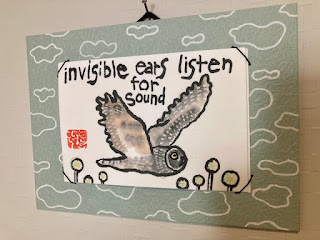
dosankodebbie, Hokkaido prefecture JP
(隠れた耳でもの音を聞く) 


 Marita McVeigh, state of Pennsylvania US

 (環境汚染問題に関心を持とう)


Hideko Sonomura, Fukui prefecture JP

 (translation: Though we are now late-stage seniors, let's continue to be close, have fun, and watch out for one another.)


Betsy Harting, state of Delaware US

 (夜更かしフクロウ)


 dosankodebbie, Hokkaido prefecture JP

 (木兎は不断日永と思ふ哉 小林一茶)


Lisa Jastram, state of Texas US

 (あなたの観点から物事を見ようとしています)


Jayne Heetderks, state of New York US

(足はダンスのためにあるもの。そーれキック!)


Paula Reeves state of Iowa US (輝き続けろ 秋の月よ)


dosankodebbie, Hokkaido prefecture JP

 ("Silver droplets falling falling..." first line of the the Ainu folktale known as The song sung by the owl god")


Owls in Japanese Culture

In Japan owls are often seen as bringers of luck and protection from suffering. The reason for this is a form of wordplay. The sound of the word for "owl" (written 梟 and pronounced fu-ku-rou) can mean "bringer-of-luck" or "no hardships" depending on which characters having the same sound are substituted for 梟.  Thus, owl ornaments and owl charms make popular gifts. Furthermore, the Ainu (indigenous people of northern Japan) honor the magnificent (and currently listed as endangered) Blakiston's Fish Owl as the guardian of the human village. Owls feature frequently in Japanese and Ainu art and literature.